
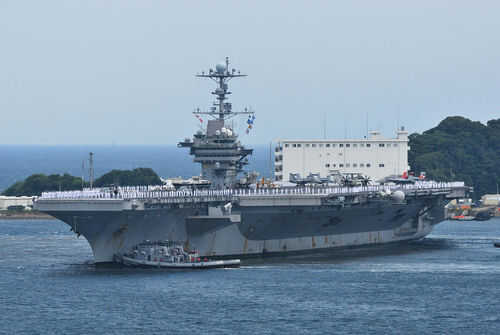
US military forces have fired upon and disabled two Iranian-flagged vessels attempting to breach a naval blockade in the Strait of Hormuz, marking a dramatic escalation in tensions that threatens one of the world’s most critical oil chokepoints.
Story Snapshot
- US Navy F/A-18 Super Hornet disabled Iranian tanker M/T Hasna with precision cannon fire after repeated warnings
- Separate incident saw US Marines seize cargo ship MV Touska after destroyer USS Spruance fired into its engine room
- Actions part of “Project Freedom” blockade operation enforcing sanctions on Iranian ports controlling 20% of global oil supply
- Trump announced seizures on Truth Social, framing enforcement as response to Iranian ceasefire violations and attacks on commercial shipping
Blockade Enforcement Turns Kinetic
US Central Command confirmed that American forces disabled the Iranian-flagged oil tanker M/T Hasna on May 6, 2026, after the unladen vessel ignored multiple warnings while attempting to enter an Iranian port. An F/A-18 Super Hornet launched from the aircraft carrier USS Abraham Lincoln fired 20mm cannon rounds into the tanker’s rudder, disabling its steering capability. The precision strike represents the first use of air-launched weapons against vessels violating the blockade established April 12 following President Trump’s announcement on Truth Social.
The Hasna incident followed an earlier confrontation on April 19 involving the cargo ship MV Touska, which was intercepted by the destroyer USS Spruance as it headed toward the sanctioned Iranian ports of Bandar Abbas and Qeshm Island. After the Touska refused compliance orders, the Spruance fired into the vessel’s engine room, crippling its propulsion. US Marines from the 31st Marine Expeditionary Unit subsequently boarded and seized the cargo ship, marking the first reported vessel seizure under the blockade operation.
Strategic Chokepoint at Center of Standoff
The Strait of Hormuz serves as a critical maritime passage for approximately 21 million barrels of oil per day, representing roughly 20% of global petroleum supply. Iran’s Islamic Revolutionary Guard Corps had effectively closed most ship traffic through the strait after April 17 attacks on US-escorted commercial vessels, citing what Tehran characterized as American “breach of trust.” The US Navy’s blockade operation, designated “Project Freedom,” aims to protect international shipping lanes while preventing Iranian vessels from accessing ports used to support what CENTCOM identifies as aggressive military activities.
This confrontation echoes historical tensions dating to the 1980s Tanker War and more recent incidents including Iran’s 2019 seizure of the British-flagged Stena Impero. However, the current escalation occurs within a more volatile context, with Iran controlling critical infrastructure around the strait while facing renewed American sanctions enforcement. The blockade effectively mirrors Iran’s own restrictions, creating a dangerous standoff where over $100 billion in annual trade flows through waters now patrolled by opposing naval forces prepared to use lethal force.
Measured Force Masks Escalation Risks
CENTCOM emphasized that both disabling operations employed precision strikes designed to neutralize vessels without causing mass casualties, reflecting rules of engagement intended to demonstrate resolve while avoiding broader conflict. President Trump characterized the actions as justified enforcement, announcing on Truth Social that US forces “blew a hole in the engine room” of the Touska and that Marines maintained custody of the seized vessel. Iranian state media countered by portraying the incidents as unprovoked aggression, particularly citing exchanges near Qeshm Island.
The limited scope of these operations may prove deceptive regarding escalation potential. Oil markets remain on heightened alert, with analysts projecting 5-10% price increases if the standoff intensifies. More concerning for Americans already frustrated by inflation and energy costs, any disruption to Strait of Hormuz traffic could ripple through global supply chains, potentially involving additional powers like China and Russia who maintain strategic relationships with Iran. The successful seizure of the Touska also provides US intelligence valuable opportunities to inspect cargo and document potential sanctions violations, suggesting the blockade serves multiple strategic purposes beyond immediate tactical enforcement.
Government Priorities Under Scrutiny
For citizens already questioning whether elected officials prioritize genuine national interests over political posturing, this naval confrontation raises fundamental questions about risk management and strategic objectives. Supporters of the blockade view it as overdue enforcement of sanctions against a regime that has flouted international norms, attacked commercial shipping, and threatened regional stability. Critics across the political spectrum, however, question whether risking conflict over oil routes serves ordinary Americans struggling with cost-of-living concerns, or primarily benefits defense contractors and regional allies with their own agendas disconnected from Main Street priorities.
The operation’s designation as “Project Freedom” and Trump’s public announcements suggest political messaging plays a significant role alongside military objectives. As American forces destroy Iranian patrol boats and missiles while maintaining round-the-clock carrier operations, taxpayers foot substantial bills for operations that could spiral into broader conflict. Whether this represents prudent deterrence or reckless brinkmanship depends largely on one’s faith that government decision-makers genuinely weigh consequences for average citizens versus electoral calculations and the influence of powerful interests invested in Middle East entanglements that have drained American resources for decades.
Sources:
US forces fire at, disable Iran-flagged tanker trying to evade blockade – Navy Times
Trump announced US Navy fired on and seized ship with Iran flag in blockade standoff – ABC News4
Raw video: US forces disable Iranian vessel violating blockade – Fox News