

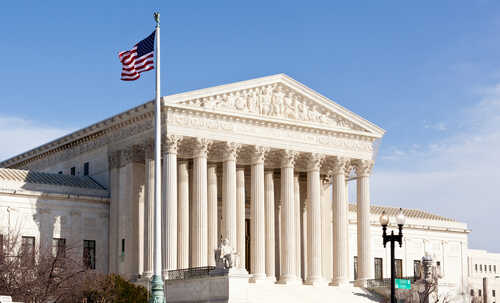
The Supreme Court has cleared the way for President Trump’s mass federal layoffs, lifting a legal blockade and empowering the executive branch to begin a historic downsizing of the U.S. government workforce.
At a Glance
- The Supreme Court lifted a lower court injunction blocking President Trump’s order to cut federal workforce levels.
- The ruling permits mass layoffs across 19 agencies, including State, Agriculture, and Veterans Affairs.
- Justice Ketanji Brown Jackson issued a blistering dissent, warning of unchecked presidential power.
- The ruling enables reductions to begin, though agency-specific legal challenges are expected.
- Unions and city governments have warned of service disruption and separation-of-powers violations.
Judicial Green Light for a Federal Purge
In a landmark decision, the Supreme Court lifted a federal court’s injunction against President Trump’s executive order directing mass federal layoffs. The unsigned ruling allows agencies to begin reducing staff levels immediately, marking a major shift in executive authority over the civil service. Agencies impacted include those long targeted by Trump’s Department of Government Efficiency.
Justice Ketanji Brown Jackson issued a blistering 15-page dissent, accusing the majority of giving Trump a “wrecking ball” to dismantle federal operations without congressional approval. She warned the Court was setting a precedent for unchecked presidential power over the government workforce.
Watch a report: Supreme Court Greenlights Trump Layoff Order
Agencies on the Brink
The ruling authorizes reductions across 19 federal departments, with up to 223,000 workers potentially affected. Early layoffs have already begun at the Department of Agriculture and Veterans Affairs, and internal plans to shutter regional offices and reduce federal contracting are accelerating. The Trump administration argues the cuts represent a necessary rebalancing of a bloated bureaucracy, as reported by the Wall Street Journal.
Critics, however, warn the layoffs are ideologically motivated and risk degrading essential services. Labor unions have called the move reckless and vowed to challenge individual agency plans in court. Some local governments say the cuts could collapse safety net functions ranging from food inspections to veterans’ care.
The original block was issued on constitutional grounds, with a federal judge finding that the executive cannot reorganize or dismantle federal agencies without approval from Congress. The Supreme Court’s order does not resolve that issue—it simply lifts the pause, allowing layoffs to begin while lawsuits proceed.
A Defining Fight Over Executive Power
Trump’s February order was framed as an effort to eliminate “deep state inefficiency,” but the legal and political stakes have since widened. With the injunction lifted, the next battle will unfold agency by agency. Observers warn that the decision could tip the balance of power between the presidency and Congress.
Lawmakers are now under pressure to respond. According to the Washington Post, a bipartisan group of legislators is drafting bills to restrict unilateral executive layoffs. Meanwhile, watchdog groups are mobilizing to monitor implementation.
Whether these moves will lead to a more efficient federal government—or a breakdown in public services—remains to be seen. What is certain: the Supreme Court has just reshaped the boundaries of executive authority in Washington.