

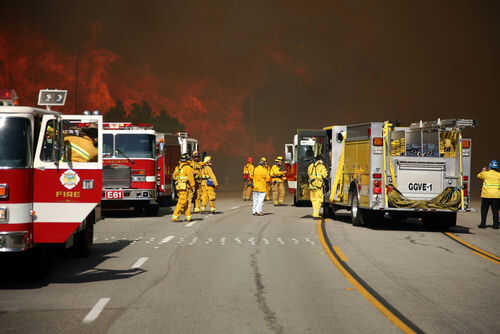
A “major incident” wildfire on Conwy Mountain has forced families from their homes and exposed just how unprepared parts of the United Kingdom remain for fast-moving fire threats.
Story Snapshot
- Emergency services declared a major incident as a large wildfire burned on Conwy Mountain near Sychnant Pass in North Wales.
- Residents in the village of Capelulo were told to evacuate, while nearby communities were warned to stay indoors out of the smoke.
- Fire crews battled the blaze in tough heatwave conditions as parts of the United Kingdom faced “exceptional” wildfire risk.
- Experts say wildfire danger in the United Kingdom is rising during extreme heat, even though big fires are still rare.
Major Incident Declared As North Wales Wildfire Threatens Homes
Emergency services in North Wales declared a major incident after a large wildfire broke out near Sychnant Pass on Conwy Mountain, above coastal communities in Conwy county. North Wales Fire and Rescue Service said firefighters were tackling a “large-scale wildfire” in steep terrain, with flames and smoke visible from miles away. The fire spread across dry grass and hillside scrub during a strong heatwave, which created hot, windy, and very dry conditions that helped the blaze grow.
North Wales Fire and Rescue Service reported that the fire began on the mountain area and moved toward popular walking routes near Sychnant Pass. Officials warned that the incident could last “for some time” due to the difficult ground and the size of the burn area. Drone and ground footage showed long lines of fire and heavy smoke drifting over nearby villages and roads as crews worked along the slopes to stop the flames from moving closer to homes and key routes.
Evacuations In Capelulo And Health Warnings For Nearby Villages
Local authorities advised some residents in Capelulo, a small village near Penmaenmawr, to evacuate their homes as a safety measure while the fire burned on the hillside above. North Wales Police helped coordinate the evacuation plan and told those affected to report to an agreed rest centre away from the fire. Families left properties in the at-risk zone as a precaution, while others waited for further advice in case the fire line changed direction overnight or with shifting winds.
Emergency services also warned people in nearby communities such as Dwygyfylchi and Penmaenmawr to keep windows and doors closed due to smoke and ash blowing off the mountain. Health officials urged anyone with breathing problems, like asthma or other lung conditions, to seek medical advice if they noticed new or worsening symptoms tied to the smoky air. Members of the public were asked not to travel to the affected area, both for their own safety and to keep roads clear for fire engines, police, and ambulances moving in and out of the scene.
Rising Wildfire Risk In A Heatwave-Prone United Kingdom
Fire experts note that serious wildfires in the United Kingdom remain less common than in places like the United States or southern Europe, but they often arrive in clusters during very hot, dry years. Research on United Kingdom fire history shows that big wildfire seasons have tended to occur in particular years with strong heat and drought, such as 1976, 2003, 2006, and 2011, rather than every single year. The Conwy Mountain blaze fits this pattern, erupting during a wider heatwave that pushed up fire danger across parts of England and Wales.
Wildfire expected to spread due to heatwave as 36 homes evacuated
The blaze broke out near Conwy Mountain and the Sychnant Pass in Conwy county on Sunday.
Read more: https://t.co/P0qfg2WSH5 pic.twitter.com/yx4XVTTPZs
— Raw feed news (@Rawfeednews) July 13, 2026
Studies of United Kingdom wildfire patterns also show that grasslands, heaths, and moorlands face some of the highest burn risks during dry spells, because they can carry fire quickly over open ground. A mapping study of the South Pennine Moorlands, which lie east of North Wales, estimated about 388 moorland fires in that region alone between 2000 and 2008, with many clustered near more populated southern areas. Those findings suggest that when heatwaves hit, communities near open hillsides and moors, like those below Conwy Mountain, can face sudden danger.
Sources:
independent.co.uk, facebook.com, gbnews.com, x.com, research.manchester.ac.uk, ourworldindata.org