

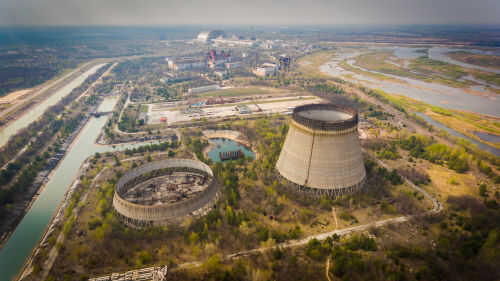
A military drone crash has ignited a catastrophic wildfire spreading across over 1,100 hectares of Chernobyl’s radioactive exclusion zone, reigniting forty years of buried nuclear fears just as modern warfare collides with humanity’s worst industrial disaster.
Quick Take
- Two military drones crashed in the Chernobyl nature reserve on May 7, sparking a rapidly expanding forest fire now covering approximately 1,100 to 1,180 hectares of highly contaminated terrain.
- Firefighting operations have been severely hampered by landmines left by Russian forces during the 2022 occupation, unexploded ordnance, and ongoing drone activity preventing safe access to affected areas.
- Strong winds and dry weather conditions are driving the fire’s rapid spread, with white smoke plumes visible from significant distances, raising concerns about radioactive particle dispersal into the atmosphere and surrounding soil.
- Ukrainian authorities report radiation levels remain within normal limits, though the fire threatens nuclear waste storage silos and could resuspend decades-old contamination through the air, water, and soil.
When War Meets Nuclear Legacy
The exclusion zone, established in 1986 following the Reactor 4 explosion that killed thousands and rendered the region uninhabitable, has become an unexpected battlefield. Russian forces occupied the area briefly during the 2022 invasion, leaving behind mines and trenches that exposed contaminated soil to the elements. Now, drone operations tied to the ongoing Ukraine-Russia conflict have triggered a disaster scenario that transcends conventional warfare concerns.
The Perfect Storm of Danger
Firefighters face a trinity of obstacles that would challenge any emergency response team. Landmines scattered throughout the zone make ground access lethal for rescue personnel. Unexploded ordnance from military operations creates secondary hazards. Meanwhile, continued drone activity—reportedly preventing firefighting efforts—introduces a fourth dimension of complexity that traditional disaster management protocols never anticipated. The combination transforms what might be a manageable wildfire into a containment nightmare.
Environmental conditions are accelerating the catastrophe. Dry spring weather and strong gusts of wind have transformed the fire into a rapidly expanding inferno that firefighting teams cannot adequately suppress. Denis Nesterov, director of the Chernobyl nature reserve, reported that by mid-afternoon on May 8, the fire had consumed approximately 1,180 hectares. Some regional officials suggested the affected area may be substantially larger, though verification remains difficult given access restrictions and ongoing military operations.
The Invisible Threat Spreads Again
Forty years after the initial disaster, radioactive particles remain embedded in the zone’s soil. Forest fires mobilize these contaminants, suspending them in smoke that travels far beyond immediate boundaries. Historical precedent matters here: the 2020 Chernobyl wildfires burned over 5,000 hectares and released measurable cesium-137 into the atmosphere, with radioactive plumes detected across Europe. Current conditions suggest a similar or potentially worse outcome, particularly given the fire’s proximity to nuclear waste storage facilities.
The state emergency service maintains that current radiation measurements remain within acceptable parameters, a statement that provides limited reassurance given measurement challenges during active fires and the historical tendency for radiation levels to spike during such events. Ukrainian authorities continue firefighting efforts to prevent the flames from reaching the volatile waste storage areas that represent an escalation scenario few want to contemplate.
A New Category of Disaster
This incident represents something unprecedented in the nuclear age: a major fire at a contaminated site deliberately hampered by military operations. Previous Chernobyl fires occurred during peacetime, allowing international coordination and resource deployment. This fire unfolds amid active conflict, with military considerations constraining humanitarian response. The precedent raises uncomfortable questions about the vulnerability of nuclear infrastructure during modern warfare and the adequacy of international protections for such sites.
Fire is spreading in the Chernobyl exclusion zone after drone crash https://t.co/qvXj8t467L in @newscientist pic.twitter.com/ZKhofqfZLW
— HealthIT Policy (@HITpol) May 8, 2026
Advocacy organizations have called for international intervention, invoking the Hague Convention’s protections for cultural and environmental sites. Whether such frameworks carry weight in contemporary conflict remains an open question. What remains clear is that the collision between industrial-age nuclear infrastructure and twenty-first-century drone warfare has created a crisis that transcends traditional categories of disaster response and demands urgent international attention.
Sources:
Drone crash sparks massive forest fire near Chernobyl nuclear plant
Large forest fire burning in Chernobyl exclusion zone after drone crash