

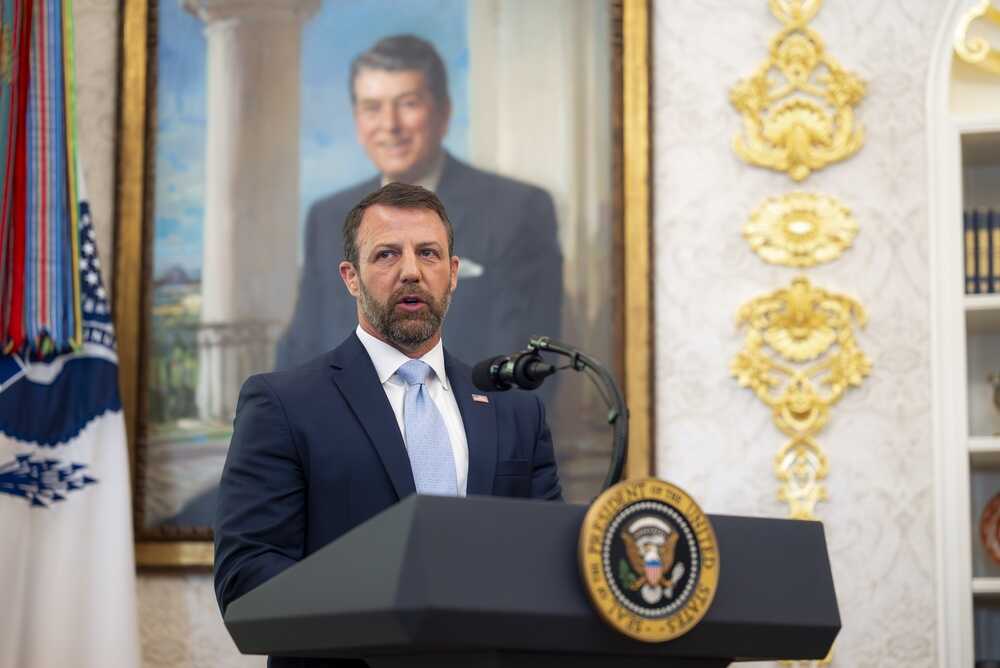
A Supreme Court ruling has unleashed mass Haiti deportations and sparked a fiery clash between Homeland Security Secretary Markwayne Mullin and CNN’s Jake Tapper over what “temporary” really means — and whether Haiti is safe at all.
Story Snapshot
- The Supreme Court’s Mullin v. Doe decision lets the Trump administration terminate Temporary Protected Status (TPS) for Haiti and Syria, clearing the way for large-scale deportations.
- DHS Secretary Markwayne Mullin says TPS was never meant to be permanent and argues courts have no role in second-guessing his decision to end it.
- Jake Tapper presses Mullin on whether Haiti is actually safe, pointing to “do not travel” advisories and extreme gang violence.
- Critics accuse DHS of ignoring required State Department consultation and country conditions, while conservatives see a long‑overdue reset of a broken “temporary” program.
Supreme Court Clears Path for Ending TPS and Mass Deportations
The Supreme Court’s 6–3 ruling in Mullin v. Doe gave President Donald Trump’s administration the green light to end Temporary Protected Status for Haitians and Syrians and move ahead with deportations.[1][12] The majority held that federal judges have no authority to review how the Department of Homeland Security decides to designate, extend, or terminate TPS for any country.[12] That means decisions about TPS now sit almost entirely in the hands of the executive branch, not unelected courts second‑guessing policy choices.
Justice Samuel Alito’s opinion stressed that the statute bars judicial review of these TPS determinations, closing the door on years of lawsuits that tried to block terminations by claiming they were “arbitrary and capricious” or racially biased.[4][12] The ruling immediately lifted lower‑court injunctions that had paused the Haiti and Syria terminations, with employers now told to treat July 1, 2026, as the effective expiration date on work documents for these TPS holders.[12] For conservatives, the decision restores clear lines of authority and reins in activist judges who had repeatedly inserted themselves into immigration policy.[16]
Mullin’s Argument: TPS Is Temporary and Courts Must Step Back
On CNN’s State of the Union, Homeland Security Secretary Markwayne Mullin leaned on the Court’s language and the plain meaning of the program’s name.[2][3] He told Jake Tapper that “Temporary Protected Status was never intended to be permanent,” noting that many Haitians first came 15 to 20 years ago and had years to seek other legal paths such as visas or lawful permanent residence.[2][3] Mullin argued that people were warned from the start that TPS could end, and that “temporary” cannot quietly become forever through court fights.
Mullin also pointed out that the legal framework gives the secretary discretion to extend TPS when the United States State Department finds a country still unsafe, but that discretion is not a guarantee.[3] He framed the current termination decision as one made jointly by the State Department, himself, and the president, weighing multiple factors — foreign policy, national security, and the strain on immigration enforcement and public resources — not just a single snapshot of conditions.[1][3] This reflects the administration’s broader view that TPS had been stretched beyond its original humanitarian purpose into a shadow long‑term status never approved by Congress.[12]
The CNN Clash: Is Haiti Safe, and Who Decides?
Jake Tapper pressed Mullin on a simple, emotional point: whether Haiti is safe enough for deportation flights.[2][8] Tapper highlighted that Haiti currently carries a level four “do not travel” advisory for Americans and is wracked by gang violence, kidnappings, and widespread crime.[8] He challenged Mullin’s assertion that those warnings mainly concern U.S. tourists, arguing that the same violence hits Haitians on the ground and does not “sound safe” for families being returned under TPS termination.[8]
Mullin responded by stressing that specialized deportation flights can operate where commercial airlines will not and insisted that decisions are made by him, the president, and the State Department after considering many factors, including security.[4] He said the administration plans to provide flights and roughly $2,100 per person to help Haitians and Syrians return home, suggesting many might help rebuild their countries.[2][3] At one point, as Tapper stacked up violence statistics without a clear question, Mullin pushed back with, “Is there a question in that?” — a moment that captured the tense divide between enforcement priorities and media narratives.[8]
Critics Claim DHS Cut Corners, Supporters See a Needed Reset
Legal advocates and academics argue that new evidence shows the Department of Homeland Security did not complete legally required consultation with the State Department before ending TPS for Haiti, despite claiming otherwise in press releases and Federal Register notices.[2] They say internal documents show no real country‑conditions review took place for the July termination and that a political appointee reversed career experts’ recommendation for automatic extension at the last minute.[2] These critics frame the move as rushed and driven by politics, not facts on the ground.
At the same time, many conservative voters view the ruling and Mullin’s stance as finally restoring common sense to a program that drifted far from its original design.[12][16] Temporary Protected Status was created to offer short‑term relief after disasters and wars, not to anchor a semi‑permanent population shielded from normal immigration rules.[5] The Trump administration has now moved to terminate TPS for 13 countries, arguing that long‑running “temporary” programs invite abuse, strain local schools and hospitals, and undermine respect for the rule of law.[12] To them, the bigger threat is not firm enforcement but decades of drift that turned clear statutes into open‑ended promises.
Human Stakes, Constitutional Questions, and the Road Ahead
The ruling and Mullin–Tapper clash highlight deeper questions many readers care about: who controls the border, and how far courts can go in rewriting immigration law from the bench.[1][4] The Supreme Court has now said that nonconstitutional challenges to TPS terminations are off‑limits, limiting future fights mainly to equal protection or other direct constitutional claims, which the Haiti plaintiffs already failed to prove.[4][12] That means Congress, not judges, must change the law if Americans want a different balance between humanitarian protections and strict enforcement.
For families with TPS, the stakes are personal and painful, and the media will keep highlighting emotional stories to push back on the policy.[5][10] For constitutional conservatives, the core issue is whether the United States remains a nation with borders, laws, and elected leaders who can act on security and economic concerns without being blocked by activist courts and “forever temporary” programs. Mullin’s showdown with Tapper shows that fight is now out in the open — and after Mullin v. Doe, it is the elected branches, not CNN commentators or lower‑court judges, who hold the final say.
Sources:
[1] Web – ‘Is There a Question in That?’ DHS Sec Mullin Battles CNN’s Jake …
[2] Web – Mullin v. Doe | Supreme Court Bulletin | LII / Legal Information …
[3] Web – As SCOTUS Prepares to Rule, New Evidence Confirms DHS Lied …
[4] Web – Supreme Court Allows Termination of TPS for Haiti and Syria
[5] Web – [PDF] 25-1083 Mullin v. Doe (06/25/2026) – Supreme Court
[8] Web – House Votes to Extend ‘Temporary’ Protected Status for Haiti for …
[10] Web – ‘Is There a Question in That?’ DHS Sec Mullin Battles CNN’s Jake …
[12] Web – Trump’s new border chief promises fewer headlines after ICE …
[16] Web – TPS Holders Challenge Termination of Temporary Protected Status …