
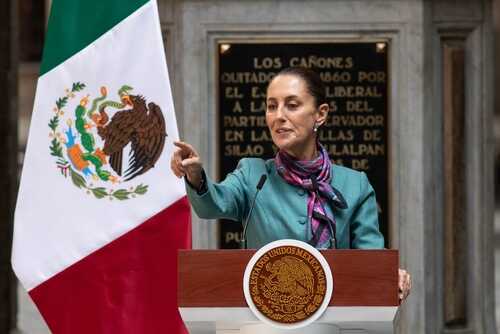
Mexican President Claudia Sheinbaum stated her objection to U.S. President Donald Trump’s request to deploy American military forces against drug cartels. The discussion centers on Mexico’s defense of its national sovereignty and the U.S. administration’s push for intervention, a policy which followed recent U.S. actions in Venezuela. This bilateral dynamic highlights the need for continued diplomatic channels amid heightened rhetoric regarding border security and narcotics trafficking.
Key Findings
- Mexican President Claudia Sheinbaum declines U.S. military deployment against cartels.
- Sheinbaum cites Mexico’s national sovereignty and ongoing bilateral cooperation as the primary approach.
- President Trump references military action following the U.S. operation in Venezuela.
- High-level diplomatic discussions continue, focusing on drug and firearms trafficking.
Mexico’s Sovereignty and Bilateral Cooperation
On January 12-13, 2026, Mexican President Claudia Sheinbaum formally stated her government’s position against U.S. President Donald Trump’s request for American military forces to operate against Mexican drug cartels. Sheinbaum referenced Mexico’s constitutional sovereignty and highlighted ongoing bilateral cooperation, citing reported progress in reducing fentanyl flows and homicides. This decision followed a 15-minute phone call between the two leaders, during which President Trump discussed the potential for military action, referencing recent U.S. actions in Venezuela.
U.S. military involvement in Mexico has been a recurring policy discussion since President Trump’s first term, where six Mexican cartels were designated as foreign terrorist organizations. The Sheinbaum administration has consistently prioritized diplomatic cooperation, showcasing verifiable results such as reduced fentanyl seizures. This approach is consistent with Mexico’s long-standing position on maintaining national sovereignty and addressing security challenges through collaboration rather than unilateral force.
Mexican President Sheinbaum:
The last time there was intervention by the United States, we lost half of our territory. pic.twitter.com/K4hvKVFvfr
— Clash Report (@clashreport) January 13, 2026
U.S. Proposal for Intervention
President Trump maintains the cartels present a significant challenge to governance in Mexico, citing military intervention as a necessary measure to address the fentanyl crisis impacting the U.S. This rhetoric has intensified following the apprehension of Venezuelan President Nicolás Maduro by U.S. forces, an operation that established a precedent for potential intervention. However, the U.S. proposal has been met with objection from Mexican officials, who state that cooperation and recent extraditions of cartel leaders already demonstrate effective bilateral efforts.
The intervention proposal has raised concerns over potential destabilization at the U.S.-Mexico border. Policy analysts argue that military action could undermine existing economic and social ties, risking human rights compliance and migration challenges. The dialogue has prompted debates in both countries, with Mexico advocating for constitutional reforms to prevent unauthorized foreign interventions, while the U.S. administration seeks tangible results from its southern neighbor concerning narcotics interdiction.
Mexico’s Sheinbaum says US military intervention ruled out after talks with Trump
Ongoing Diplomatic Channels
As of mid-January 2026, diplomatic channels remain active, with high-level talks focusing on the fentanyl crisis and firearms trafficking. Despite President Trump’s position on the need for military intervention, President Sheinbaum has consistently stated that such measures are “not on the table.” The Mexican government continues to report progress in reducing homicides and drug flows, reinforcing the effectiveness of current bilateral cooperation without resorting to military action.
The ongoing dialogue between the U.S. and Mexico underscores the complex policy dynamics, where national sovereignty and cooperation are weighed against calls for military intervention. While the U.S. administration seeks to resolve narcotic issues via all available options, Mexico’s commitment to diplomatic resolutions remains a steadfast and documented policy position, highlighting broader implications for the future of U.S.-Mexico relations.
Watch the report: Mexico’s Sheinbaum rejects Trump’s threat of US strikes on drug cartels
Sources:
Mexican President Tells Trump US Intervention Against Cartels is ‘Unnecessary’
US Troop Deployment in Mexico Not on the Table, President Claudia Sheinbaum Tells Trump
Sheinbaum Declines Trump Offer to Use U.S. Military in Mexico on Phone Call
US Troops in Mexico Not on the Table, Sheinbaum Tells Trump