
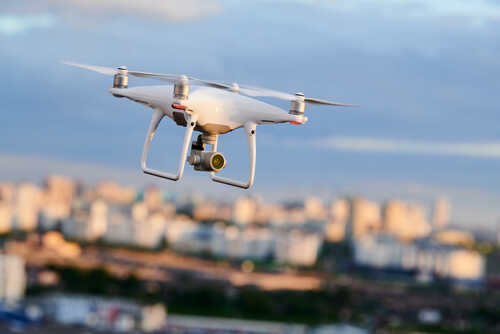
Defense insiders are quietly sketching a future where one U.S. soldier, backed by artificial intelligence, commands vast swarms of drones while America’s enemies race to do the same. This radical shift replaces the one-operator-per-drone model with a “human-on-the-loop” concept where a single warfighter supervises dozens or hundreds of semi-autonomous systems. Real-world conflicts, like those in Ukraine and the Red Sea, are proving grounds for mass, cheap drones, accelerating an AI and swarm arms race. As the Pentagon pushes to field hundreds of thousands of these low-cost systems, the transition raises critical questions about human oversight, constitutional accountability, and the ethical red lines conservatives must insist upon.
Story Snapshot
- Robotics and defense professionals now openly describe future battlefields where one soldier oversees swarms of AI-driven drones instead of one drone per operator.
- Real-world wars in Ukraine and the Red Sea are test beds for mass drones, pushing the Pentagon and U.S. allies into an AI and swarm arms race.
- Key U.S. programs aim to field hundreds of thousands of low-cost drones, raising serious questions about accountability, ethics, and command.
- Conservatives must insist AI warfare stays under firm human, constitutional, and U.S.-controlled oversight, not globalist or unaccountable tech agendas.
From One Man, One Rifle To One Soldier, One Swarm
For generations, American warfighters carried rifles, drove tanks, or piloted aircraft; now robotics insiders envision a battlefield where a single soldier directs an entire flock of drones, with AI doing most of the tactical thinking. The concept replaces today’s one-operator-per-drone model with one human supervising dozens or even hundreds of semi-autonomous systems. Instead of manually flying each platform, the soldier sets intent and rules of engagement while algorithms handle navigation, target detection, and coordination.
This model, often called “human-on-the-loop,” keeps a person in supervisory control but lets software act at machine speed in complex, fast-moving fights. That might sound efficient, but it also concentrates enormous power and risk in a single console. A glitch, hack, or misidentification in the AI stack does not just ground one drone; it could send an entire swarm off course, potentially endangering civilians, allied forces, or U.S. assets with very little time for human correction.
Robotics industry insider says the future is one soldier backed by AI controlling swarms of drones https://t.co/SnRUR6P11c
— Shehzad Younis شہزاد یونس (@shehzadyounis) December 10, 2025
Ukraine, The Red Sea, And The New Drone Arms Race
Ukraine’s battlefields and the Red Sea’s shipping lanes are already showing how mass cheap drones are transforming war. Both Ukraine and Russia rely heavily on FPV quadcopters, loitering munitions, and networked UAVs for surveillance, artillery spotting, and precision strikes, sometimes coordinating several platforms at once. In the Red Sea, Houthi forces have used drones and missiles to harass international shipping, forcing navies to field increasingly automated defenses just to keep up with the volume of incoming threats.
These real-world laboratories prove that quantity, networking, and autonomy can beat older assumptions built on a few exquisite, manned platforms. U.S. and allied planners are responding with ambitious unmanned buildup plans that would put hundreds of thousands of small, expendable drones into the field. That scale virtually guarantees heavier reliance on AI for sensing, tracking, and engagement decisions. For conservatives, the question is whether this race stays anchored in American sovereignty and clear chains of command, or drifts toward opaque algorithmic control and multinational compromises.
“You can scale drone manufacturing much more than you can pilots,” Ark Robotics told BI.
Inside The Pentagon’s Push For AI Targeting And Swarm Control
Recent Navy documents show how quickly AI is being woven into command-and-control. One key request for industry seeks automatic target recognition and tracking software for maritime helicopters that can handle multiple drones or small boats at once and then present those tracks to a supervising human. Defense contractors are marketing AI-powered counter-drone systems that fuse radar, electro-optical, and other sensors to recommend engagement options against complex swarms, borrowing heavily from missile-defense automation originally built for systems like Aegis.
At the same time, a massive unmanned buildup is being cast as essential to deter near-peer rivals and saturate contested airspace with cheap, attritable systems. The underlying assumption is clear: no human can manually track, classify, and prioritize that many fast-moving contacts; only AI can. That reality makes the human-machine interface the last line of constitutional accountability. How threats are displayed, how quickly lethal options appear, and how easy it is to override the system will determine whether the soldier remains in charge—or becomes a rubber stamp.
Ethics, Accountability, And The Conservative Red Lines
As AI takes over more of the “find, fix, finish” process, the legal and moral burden does not disappear; it shifts onto policymakers and designers who choose how much autonomy to allow. International law still demands distinction between combatants and civilians and proportional use of force, but algorithmic misfires can happen in milliseconds, far faster than a court or Congress can react. That is where conservatives’ instinct for limited government and clear responsibility becomes critical to shaping AI warfare policy.
Future doctrines that promise “one soldier, one swarm” may reduce American casualties and deter adversaries, but they also raise hard questions: Who is liable when an autonomous drone makes a wrong call? How do we prevent mission creep from foreign battlefields into domestic surveillance? And how do we ensure American-made AI weapons stay under U.S. constitutional control rather than globalist governance or corporate black boxes? Those are the debates patriots must engage now, before the software is fully fielded and the swarm era locks in.
Robotics industry insider says the future is one soldier backed by AI controlling swarms of drones: https://t.co/KioMUJCrZ4
— Randy Kemp (@randylewiskemp) December 10, 2025
Sources:
AI in Warfare: What You Need to Know
Navy seeks AI for automatic target recognition, tracking of drones and vessels from helicopters
Robotics industry insider says the future is one soldier backed by AI controlling swarms of drones.
300,000 Drones: What Hegseth’s Drone Build Means and What We Still Need to Know