

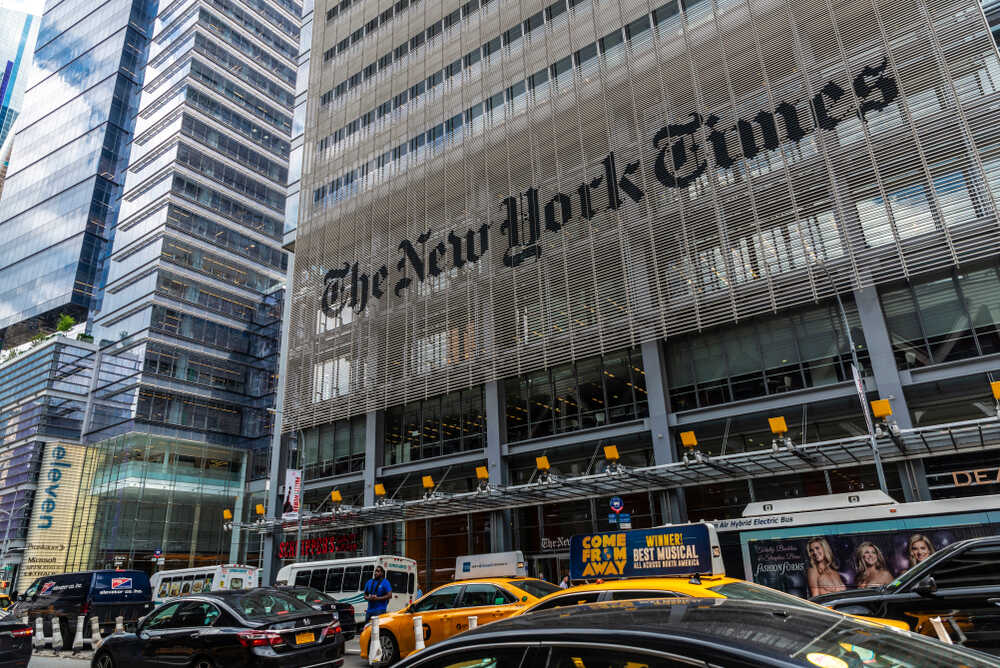
A massive $15 billion libel fight between President Trump and The New York Times is now cleared to move forward in a Florida courtroom, putting legacy media’s election-year attacks under a much brighter spotlight.
Story Snapshot
- President Trump’s $15 billion defamation case against The New York Times and Penguin Random House continues in the U.S. District Court for the Middle District of Florida.
- The lawsuit targets two New York Times articles and the book “Lucky Loser”, claiming they falsely brand Trump as a failed businessman and were timed to hurt his 2024 campaign.
- A federal judge tossed Trump’s first 85-page complaint as “improper and impermissible,” but allowed a shorter, revised filing instead of ending the case.
- The New York Times calls the case “meritless” and says Trump has not shown “actual malice,” while critics say the suit tries to chill tough reporting on powerful figures.
Trump’s Florida Defamation Case: What He Is Arguing
President Donald Trump filed this defamation lawsuit in the Middle District of Florida on September 15, 2025, seeking $15 billion in damages from The New York Times, Penguin Random House, and several reporters. His team says the paper and publisher defamed him “per se” and “per quod,” legal terms for serious attacks on a person’s reputation. The core claim is simple enough for any reader: they say the Times and its book partner lied about Trump’s business record and did it to sway voters in the 2024 election.
The amended complaint now focuses on two articles and one book. One article is by reporters Susanne Craig and Russ Buettner, another by Peter Baker, and the book is titled “Lucky Loser: How Donald Trump Squandered His Father’s Fortune and Created the Illusion of Success.” Trump argues these works paint him as a fake success story who wasted his father’s money and only became famous through television, ignoring decades of real business achievements. His lawyers say this is not tough opinion, but false statements presented as fact.
Judge Slaps Down the First Filing but Keeps the Courthouse Door Open
A federal judge in Tampa, Steven Merryday, struck Trump’s original 85-page complaint, but did so on procedure, not on the truth of the claims. He called the first document “tedious and burdensome” and said it looked more like a public-relations blast than a proper legal filing. The judge said a complaint is “not a public forum for vituperation and invective” and gave Trump’s team 28 days to file a tighter, 40-page version that sticks to clear legal claims. That means the case itself was not thrown out; it was sent back for a cleaner re-write.
Trump’s lawyers responded with a shorter, 40-page amended complaint, filed in October 2025. This new filing drops one earlier named reporter, Michael S. Schmidt, narrowing the target list, but keeps the same $15 billion damages demand. It also adds a formal request that the Times and Penguin Random House retract the book and articles. For many conservatives, this step matters: it signals Trump is not just chasing money or headlines, but wants the record corrected in the public square.
Media Pushback: “Meritless” and “A Political Document”
The New York Times has answered with strong language of its own. In a public statement, the company says Trump’s lawsuit “has no merit” and is “an attempt to stifle and discourage independent reporting.” After Judge Merryday struck the first complaint, the Times said it welcomed the ruling and called the filing “a political document rather than a serious legal filing.” Penguin Random House also backs the authors, saying they stand by Lucky Loser and view Trump’s claims as baseless.
Outside groups on the left echo that message. The Knight First Amendment Institute and other advocacy organizations argue Trump’s suit “weaponizes defamation law” to scare reporters away from digging into powerful figures. They say Trump has not clearly identified specific false statements or proven “actual malice,” the high standard public officials face because of a Supreme Court case called New York Times v. Sullivan. To win, Trump would need to show the journalists either knew their claims were false or pushed them with reckless disregard for the truth. That bar is tough by design, especially when the target is a major national outlet.
Why This Fight Matters for Conservative Readers
For many conservatives, this case is about more than one book or a couple of articles. It taps into a long-running pattern where big media brands act like partisan players and then hide behind the First Amendment when called out. A recent law review study notes Trump has used defamation suits as one tool against outlets he views as biased, including The Wall Street Journal, the BBC, and the Pulitzer Prize Board. Critics say this is “litigation as a weapon,” but many on the right see it as the only way to push back against information warfare dressed up as “news.”
At the same time, the legal deck is stacked in favor of large media companies. Courts demand exact proof of false factual claims plus actual malice, and most big-ticket defamation cases against major outlets fail. That reality leaves many readers feeling that powerful institutions can smear, spin, and selectively “fact-check” with almost no real accountability. Trump’s lawsuit moving forward in Florida keeps the pressure on those institutions. Discovery and depositions could force editors and reporters to explain their sources and motives under oath, which is something transparency-minded conservatives have wanted for years.
Sources:
reason.com, abcnews.com, clearinghouse.net, reddit.com, nytimes.com, facebook.com, knightcolumbia.org, nbcnews.com, nytco.com, freedomforum.org