
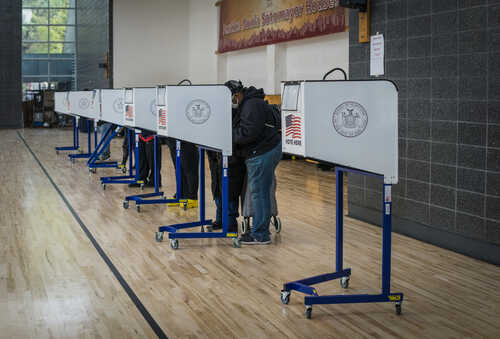
Arizona’s voter database is under siege after a massive system failure left over 200,000 voter registrations improperly verified, triggering a statewide crisis of confidence.
At a Glance
- Over 200,000 Arizona voter records were misclassified due to a data system error.
- The flaw stems from Motor Vehicle Division database coding failures.
- Governor Katie Hobbs initiated an independent audit to investigate.
- Affected voters are now being contacted for citizenship proof.
- Proposed legislative reforms aim to prevent future errors.
Data Catastrophe Exposed
Arizona’s voter integrity is under fire after revelations that a pervasive database error led to the wrongful verification of 218,000 voter registrations. This malfunction, linked to the Motor Vehicle Division’s (MVD) decades-old data systems, inaccurately marked non-citizens as having submitted the legally required proof of citizenship under Arizona’s strict documentation laws.
Officials only discovered the breach in September 2024, despite its existence since the late 1990s. The MVD’s modernization attempts failed to correct legacy data gaps, especially for licenses issued prior to October 1996 that lacked citizenship details. Investigators confirmed that the flaw was administrative—not fraudulent—but the scale of the error has prompted urgent state-level intervention.
Watch a report: Arizona Error Requires Thousands to Provide Proof of Citizenship
Former county recorders Patty Hansen and Leslie Stallworth-Pouquette led an exhaustive audit ordered by Governor Katie Hobbs, which was published in February 2025. The audit revealed systemic breakdowns in data coordination between the MVD, Secretary of State’s Office, and county recorders. It also highlighted obscure legal loopholes affecting U.S. nationals from territories like American Samoa and Swains Island.
Statewide Scramble to Rectify
The fallout has forced Arizona’s counties into a massive verification campaign. While documentation confirming citizenship was located for about 20,000 affected voters, nearly 200,000 still face scrutiny. County officials must now individually contact these voters, requesting formal proof to confirm their eligibility—an administrative task of unprecedented scale.
This administrative juggernaut adds strain to county recorders, who are already contending with rising public skepticism about election security. As Votebeat’s investigation details, the human cost is equally severe: voters, especially those with pre-1996 licenses, risk being disenfranchised through no fault of their own.
Critics warn that the fallout could disproportionately affect certain voter groups, raising concerns of inadvertent disenfranchisement on a massive scale. With thousands at risk of losing their voting rights unless they can rapidly produce documentation, advocacy groups are calling for safeguards to prevent eligible voters from being swept up in bureaucratic errors. While some political observers speculate that such situations could be leveraged to restrict voter rolls, no direct evidence has emerged tying this specific failure to partisan manipulation.
Governor Hobbs’ administration is advocating for swift legislative solutions. According to Democracy Docket, reforms under consideration include stricter data-sharing protocols between agencies and tighter voter ID verification mechanisms.
Trust on the Brink
Beyond the immediate fixes, Arizona’s election apparatus faces a longer battle to restore public trust. The revelation plays directly into national anxieties over election integrity, despite the absence of fraud in this case. Experts warn that without clear communication and transparent remediation, voter confidence could suffer irreparable harm.
This debacle also serves as a stark warning to other states reliant on legacy data systems. As ABC15 reports, the confluence of outdated infrastructure and poor inter-agency coordination can open the floodgates to systemic errors that jeopardize the democratic process.
Arizona’s response, while decisive, must now translate into durable reforms—both to reassure voters and to inoculate the state against future administrative disasters. The nation is watching closely, with the integrity of not just one state’s elections, but the broader democratic system, hanging in the balance.