

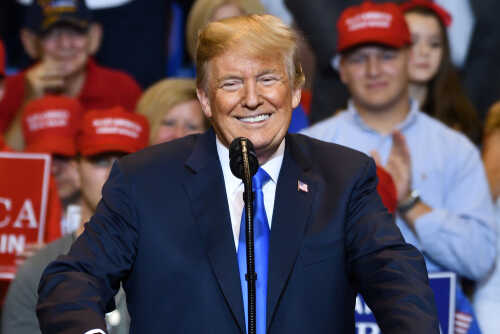
President Donald Trump sought to tie immigration directly to violent crime in Washington, D.C., signaling that his administration will lean heavily on linking border policy with urban safety debates.
At a Glance
- Trump linked immigration to violent crime during remarks in Washington, D.C.
- City data shows violent crime fell by roughly 30% in the first half of 2025
- Trump pledged to deploy more federal agents in urban centers
- Immigrant advocacy groups rejected claims of a crime-immigration link
Crime, Immigration, and Policy
Speaking in Washington on August 18, President Trump claimed that the nation’s capital has become a showcase of how unchecked immigration drives violent crime. He argued that urban centers are “overwhelmed” by newcomers and pledged that his administration would use federal resources to restore order.
The remarks came despite recent official statistics showing that violent crime in Washington has fallen significantly compared to the previous year. According to the city’s police department, homicides and carjackings are down nearly 30% in the first half of 2025. These figures stand in contrast to Trump’s portrayal of a city in crisis, underscoring the political nature of his message.
Executive Priorities
Trump’s framing of Washington as emblematic of national security risks reflects a broader policy stance to fuse immigration and crime into a central governing theme. He suggested that federal intervention would be necessary to supplement local law enforcement, echoing earlier measures he pursued in his first term when federal agents were sent into several U.S. cities.
This approach could appeal to constituents who view immigration and public safety as intertwined, particularly in urban areas where concerns about law enforcement resources are pronounced. However, researchers have consistently found little evidence of a direct correlation between immigration levels and violent crime rates. Several studies, including analyses of major U.S. cities over multiple decades, have concluded that immigrants are less likely than native-born citizens to commit violent offenses.
Pushback and Rebuttal
Immigrant advocacy organizations quickly responded to Trump’s remarks, arguing that his comments misrepresent both the realities of urban crime and the role of immigrant communities. Leaders from these groups emphasized that migrants contribute significantly to the city’s economy and civic life, and that scapegoating them diverts attention from the complex social and economic factors that drive violence.
Local officials also weighed in, noting that Washington has invested heavily in violence prevention programs and community-based policing, which they credit for the recent decline in violent crime. While acknowledging ongoing challenges, city leaders rejected the suggestion that immigration is the driving factor behind public safety concerns.
Governing Through Narrative
Trump’s strategy places immigration squarely at the intersection of national security, law enforcement, and executive authority. By tying urban crime to border control, he is reinforcing a governing message that sharpens partisan divides and defines his second term. For opponents, the challenge will be addressing public safety concerns while countering narratives that link migration with violence.
The episode illustrates how crime statistics and lived realities can be reshaped into political arguments. Whether Trump’s approach reshapes public opinion may depend less on the accuracy of the numbers than on the anxieties Americans bring to the national debate.
Sources
The New York Times
Washington Post
Pew Research Center